From 1 December 2026, the Australian Government Digital ID System (AGDIS) opens to the private sector. Businesses can apply to use it to verify their customers, and accredited private identity providers can apply to join it. From 1 January 2027 at the latest, businesses that rely on myID, the Digital ID provided by the Australian Taxation Office (ATO), will start paying for each check.
This is the moment the Digital ID Act 2024 was designed for, and it will get plenty of attention. It also brings a long-running source of confusion to the surface. Digital IDs, identity verification services, digital driver licences and verifiable credentials are often talked about as if they were the same thing. They are not. Once one of them carries a per-check fee, the difference stops being technical and becomes a practical commercial decision with a cost attached.
This guide is for anyone trying to work out what the change means for their organisation. It sets out what is changing, the main ways to verify identity in Australia today, what each one is good at, and what is still unsettled. It builds on our earlier article, which looks at how the wider system fits together.
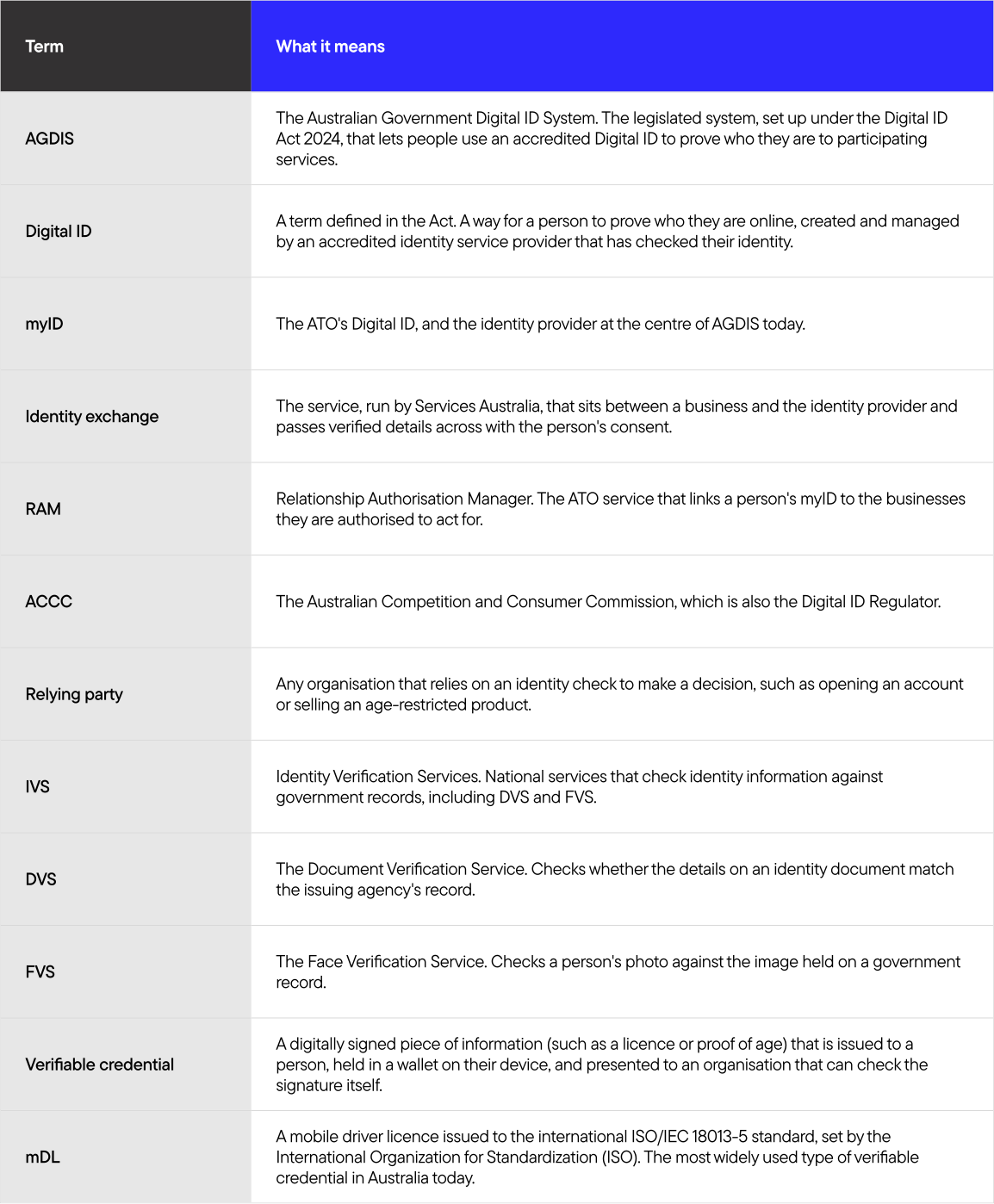
The terms you will hear
What actually changes on 1 December
The Digital ID Act has rolled AGDIS out in phases. The first two brought in Commonwealth services, then state and territory providers. The final two phases start on 1 December.
There are two different ways in, and they are easy to mix up.
Relying parties. Businesses that want to verify their customers through AGDIS need approval from the ACCC, but they do not need to be accredited.
Providers. Identity, attribute and identity exchange providers need both: accreditation, and then separate approval to participate. Accreditation on its own does not let a provider offer services through the system.
Once approved, an organisation goes on the AGDIS Register and starts from a date the Regulator sets. So 1 December is when applications open, not the day businesses start using myID at scale. Each application has to be assessed, and each integration built and tested. The government has previously said it expects five to ten private identity providers to take part at first.
In practice: A regional credit union wants new members to be able to verify with myID when they join online. It applies to the ACCC as a relying party and does not need accreditation. An identity verification company that wants to offer its own Digital ID inside AGDIS has a longer path: accreditation first, then approval to participate. Both then build and test their integration before they go live.
Three ways to verify identity, side by side
Organisations in Australia have three broad options for checking who someone is digitally. They are often presented as competitors. In practice they do different jobs, and many organisations will use more than one. This section is a short overview; our upcoming guide goes into each one in more depth.
1. Identity Verification Services (DVS and FVS)
How it works. The customer provides details from an identity document, and for FVS a photo. The business, usually through a gateway provider, checks them against the issuing agency's record. A DVS or FVS check costs businesses A$0.40 plus GST under the Identity Verification Services Rules 2024, before gateway providers add their margin.
Where it fits. Remote onboarding and established compliance processes. IVS is mature, widely used and already built into many onboarding systems.
What to weigh. Each check is a one-off verification event. The result usually stays with the business that ran it, so the customer goes through a similar process again with the next organisation. The business also collects and handles the document details itself.
In practice: An online lender asks a new applicant to enter their driver licence number and take a selfie. Its gateway provider checks the licence details through DVS and the photo through FVS, and the lender approves the application. A month later, the same person opens a mobile plan and goes through a similar set of checks with the telco.
2. AGDIS and myID (a Digital ID)
How it works. The business sends the person to the identity exchange. The person signs in with myID and consents to share, and the exchange returns the verified details the business asked for. For a Strong myID, the ATO has checked the person's identity documents with the issuer and matched their face against their passport photo with a liveness check. The proofed identity stays with the ATO, and every check runs through government infrastructure.
Where it fits. Online interactions where an organisation wants to draw on an established, government-run identity check. myID is already widely adopted, with around 15 million Digital IDs, and a Strong myID combines document checks, face matching and liveness detection. It is also an option for people who do not have a digital licence.
What to weigh. Businesses will pay per check, at a price still to be set. Joining requires ACCC approval and an integration with the exchange. Liability settings are still being worked through. And joining AGDIS does not, on its own, let an organisation accept an mDL. That is a separate decision.
A note on language: the privacy regulator describes myID as both an identity provider and a credential provider. "Credential" here means the login people use to sign in, not a verifiable credential.
In practice: A national telco lets new customers sign up online by verifying with myID. The customer signs in with their Strong myID and agrees to share their verified name and date of birth. The telco relies on the identity check the ATO has already done, without collecting or storing passport images, and each check becomes a billable transaction once charging begins.
3. Verifiable credentials, led by the mDL
How it works. The state or territory checks the person's identity once, when it issues the licence. The person then holds a signed credential in a wallet on their phone and presents it directly to the business, which checks the issuer's signature against a list of trusted issuers. No one else is involved in the transaction. The government's own explainer is clear that digital driver licences "are not a Digital ID on their own".
Where it fits. In-person and online interactions, from onboarding to age checks and repeat visits. Because the person presents the credential directly, they can share only what is needed: a credential can confirm someone is over 18 without revealing their date of birth or address.
What to weigh. Availability and acceptance still vary by state and territory, so national businesses may need to support more than one credential. Organisations need verification software or devices that can read credentials. Online acceptance is newer than in-person use, and guidance on relying on credentials for regulated processes is still developing.
In practice: A bottle shop checks a customer's mobile driver licence at the counter. The reader confirms the licence was issued by a recognised state authority and that the customer is over 18. Staff never see the customer's date of birth or address, and nothing is stored.
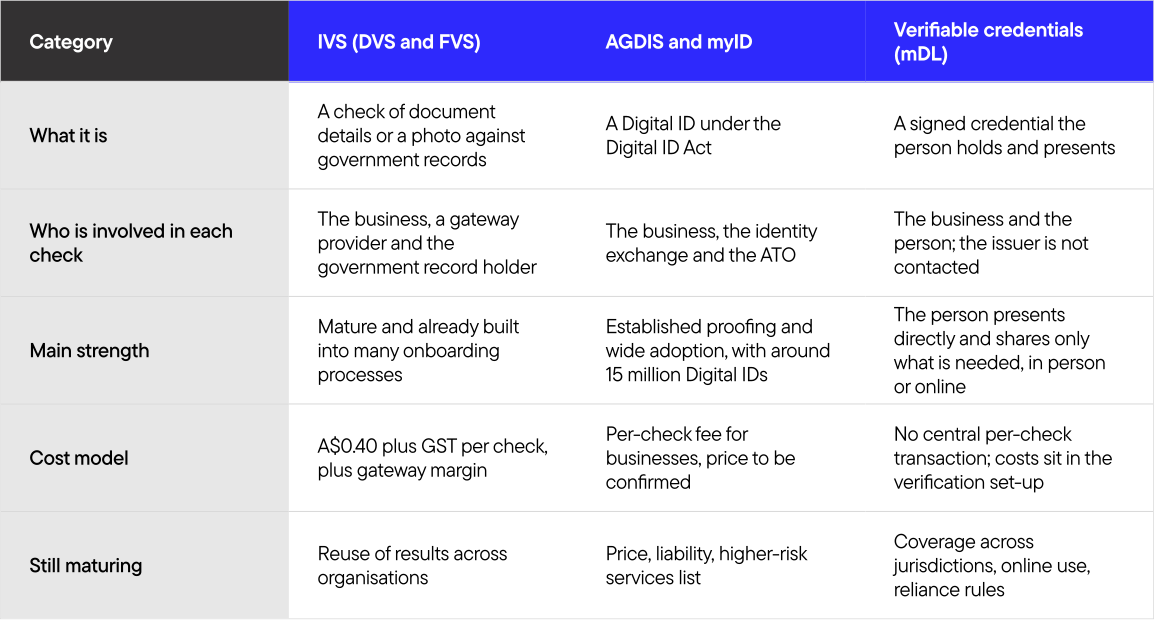
At a glance
What the price changes
The charging settings came out of the 2026-27 Budget. Individuals keep using myID for free, and so do government services. Businesses pay, but only when they use myID as a relying party listed on the AGDIS Register. The government has said it will be a simple per-transaction fee, invoiced in arrears, with the price set after a mandatory 28-day public consultation and reviewed after a year. RAM and the Services Australia exchange stay free for businesses for now, although that may change as the private market matures.
The stated aim is competitive neutrality: a government-backed identity service should not undercut the private providers it is inviting in.
To be confirmed: the myID price: At the time of writing, the pricing consultation has not opened. With charging due by 1 January, the window is short. Just as important as the price is what it buys: which myID identity strengths (Basic, Standard or Strong) businesses will be able to ask for, and whether the fee varies by strength. We will update this section once the consultation opens and a price is proposed.
The obvious benchmark is the A$0.40 DVS fee. For a rough sense of the cost side, the ATO has about A$357.4 million over four years to operate and secure myID, and AGDIS handled more than 113 million authenticated transactions in the year to April 2026. Spread evenly, that is around A$0.79 a transaction.
That is our arithmetic, not a government figure, and it overstates what businesses will pay because government use stays free. But it shows why the price could land on either side of A$0.40.
In practice: An insurer that runs 200,000 remote identity checks a year would pay about A$80,000 at A$0.40 a check, or about A$158,000 at A$0.79. Every 10 cents on the final price adds A$20,000 a year. These figures are illustrative only, but they show why it is worth knowing which checks need a Digital ID and which could be handled another way.
What is still unsettled
The price is the most visible gap, but it is not the only one. None of these stops the opening going ahead, but the first organisations through the door will be making decisions without some of the information they need.
To be confirmed:
- The higher-risk services list: Government services where identity fraud could seriously affect someone's finances will only accept government Digital IDs. The government has said it will publish which services those are. Until it does, private providers cannot see how much of the government market is open to them.
- Liability: The Act protects providers through a statutory contract and a liability shield, but how liability sits between identity providers and relying parties is still open. The government has said it will consult on further measures, including caps. This matters most to banks and telcos, because it shapes their risk, insurance and investment decisions.
- Connections between identity exchanges: How private identity exchanges such as ConnectID will connect to AGDIS is still being worked through by the Department of Finance. For many businesses, that connection is how they would actually reach myID.
In practice: A bank's product team is keen to offer myID at onboarding. Its risk team can approve a limited pilot, but holds back a full rollout until the price and liability position are known, because both feed into the business case and the bank's insurance arrangements.
Two tracks running in parallel
While AGDIS has been expanding, work on verifiable credentials has been moving on a separate track.
The 2024-25 Budget funded a pilot of government digital wallets and verifiable credentials across the ATO, Finance and Services Australia. One of its proofs of concept tested a verifiable credential version of myID and RAM business authority details. Since then, the work has focused on policy: a request for information in late 2025, a verifiable credentials policy consultation from May to July 2026, and a Commonwealth Verifiable Credential Trust Framework being developed through 2026-27.
In February 2026, Commonwealth, state and territory ministers agreed a priority set of nationally interoperable verifiable credentials built on ISO standards: driver licences, proof of age and photo ID cards, birth certificates, Medicare cards and passports. myID and RAM are not on that list today.
So there are currently two tracks. One is AGDIS: a regulated, exchange-based system with myID at its centre and a fee for business use. The other is a growing set of government-issued credentials, led by the mDL, that people hold and present themselves. That does not mean the tracks will never meet. A myID credential has already been tested, and the frameworks being developed now could connect them in future. For the moment, though, they are separate decisions with separate rules.
In practice: A car rental company accepts mobile driver licences at the counter today, because a licence is what it needs to see. It is also considering myID for online pre-registration, for customers who do not yet have a digital licence. And it is keeping an eye on the Commonwealth trust framework, which may shape which other credentials it can accept later.
What it means for you
For most organisations, the useful questions are the same whichever option is on the table:
- Can we rely on it for our compliance obligations?
- How does it fit with the checks we already run?
- How do we get access to it?
- What will it cost to set up and operate?
It is not a choice between one option and another. myID brings established proofing and wide adoption. Credentials let people share only what is needed, in person or online, without a central transaction behind every check. IVS remains the backbone of many existing processes. Most organisations will end up using more than one.
The biggest risk is confusion. Coverage in December will focus on myID, and some organisations may read that as the single government-backed option and pause other plans. In reality, the credentials that governments have agreed to prioritise are developing alongside it, and both are worth understanding.
What to do now
Understand the options available to verify identity. Before choosing, it helps to know what each approach does, where its trust comes from and what it can be relied on for. The overview above is a starting point, and our upcoming guide untangles it in more detail.
Be clear about which decision you are making. Joining AGDIS as a relying party, becoming an accredited provider and accepting mDLs are three different things, with different rules and different costs. You may need one, two or all three.
Watch for the pricing consultation, and take part. It runs for 28 days, it should open soon, and it is the main opportunity to shape a fee that will apply from January.
Map your identity checks by type. Remote onboarding, in-person checks, age checks and repeat logins have different needs. A per-check fee looks very different across them, and so does the case for a credential the customer already carries.
Keep credential plans moving alongside. The national priority list has been agreed and mDLs are already live in several states and territories. Nothing about 1 December changes that. Organisations that plan for both tracks will be better placed than those that wait for everything to settle.
Coming up: "My ID is on my phone." Great. Which one?
Customers can now prove who they are with a document check, a Digital ID such as myID, or a licence or other credential on their phone. Our next piece is a plain-English guide to help businesses tell these apart and work out which one they are being shown.It will cover the difference between ISO and non-ISO digital licences, how the legal footing of each approach compares, how the different levels of assurance line up, and an acronym descrambler for the terms that make all of this harder to follow than it needs to be.As you read this one, it is worth noting the questions you would want answered before choosing.
If you are working through which pathway fits a particular use case, we are always happy to compare notes.