

Banks already perform some of the most important trust-establishing work in a customer’s digital life.
During onboarding, a bank may verify government identity documents, run biometric and liveness checks, complete AML/KYC processes, validate contact details, assess device signals, and screen for fraud. That moment is often one of the highest-assurance identity events a customer will experience with any private-sector organisation.
Yet in many banking journeys, the value of that trust is still captured only once.
The customer is verified. The account is opened. Evidence is stored. Then, when the customer returns for a new product, a high-risk action, recovery, branch interaction, or business banking authority check, the bank often has to rebuild confidence again.
Each check may be appropriate on its own. Together, they create cost, friction, risk, and operational drag.
The opportunity now is to move from verification as a one-time event to trust as a reusable capability.
The idea of a reusable bank identity is gaining momentum.
A recent thought leadership piece from iDX3 makes the case clearly: banks have already paid to establish trust during onboarding, but often write off much of that value once the initial account opening journey is complete. The paper argues that issuing a reusable bank identity after onboarding could turn that trust into a strategic asset — supporting faster future journeys, lower repeat-verification costs, stronger recovery, and new partnership opportunities.
That is an important shift in thinking.
Banks do not only issue accounts, cards, tokens, and credentials for payment. They also create trusted relationships.
- They know when a customer has been verified.
- They know when an account relationship exists.
- They know when a person is authorised to act.
- They know when a customer has met certain eligibility, risk, or assurance thresholds.
The strategic question is whether that trust remains locked inside a workflow, or whether it can become reusable under the right controls.
But a bank identity is only one expression of a broader trust layer
A reusable bank identity is a compelling starting point. But the deeper opportunity is bigger than a single credential.
Banks will need digital credential infrastructure that can support multiple trust patterns over time:
- accepting trusted credentials from governments, schemes, partners, and other issuers
- issuing credentials that represent relationships the bank already knows to be true
- verifying credentials across digital, branch, assisted, and partner channels
- applying policy and trust rules before accepting a credential
- managing status, revocation, lifecycle, and assurance over time
- supporting selective disclosure and customer consent
- integrating credential signals into existing onboarding, fraud, authentication, and servicing flows
In other words, the strategic capability is not just “issue a bank identity.”It is the ability to create, carry, verify, and govern trusted facts across the banking relationship.
Reusable trust should complement existing controls, not replace them
This distinction matters.
Digital credentials should not be positioned as a replacement for KYC, fraud analytics, authentication, device intelligence, biometrics, or risk scoring. Those controls remain essential.
Continuous authentication and fraud systems help answer questions such as:
- does this session look normal?
- is this device familiar?
- does this behaviour suggest risk?
- should this action require step-up?
Digital credentials answer a different set of questions:
- can this customer present a source-verified identity or attribute?
- was it issued by a trusted source?
- is it still valid?
- can only the required information be disclosed?
- can an account relationship or delegated authority be proven without starting again?

The strongest model combines both.
Authentication and risk controls evaluate the interaction in progress. Digital credentials provide a source-verified trust anchor at the handoff.
That is why credential infrastructure is best understood as a new trust layer, not a replacement for the bank’s existing security and compliance stack.
Where the value can show up first
The practical opportunity is to focus on workflows where reverification already creates measurable pain.
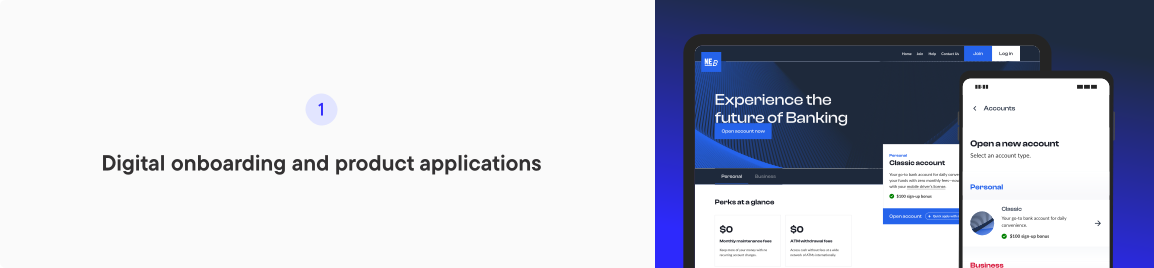
If a customer has already been verified, there may be opportunities to reduce friction when they apply for additional accounts, credit products, wealth services, business banking products, or digital wallet enrolment.
A reusable credential-backed signal can help reduce repeated document capture, manual review, data entry, and abandonment.
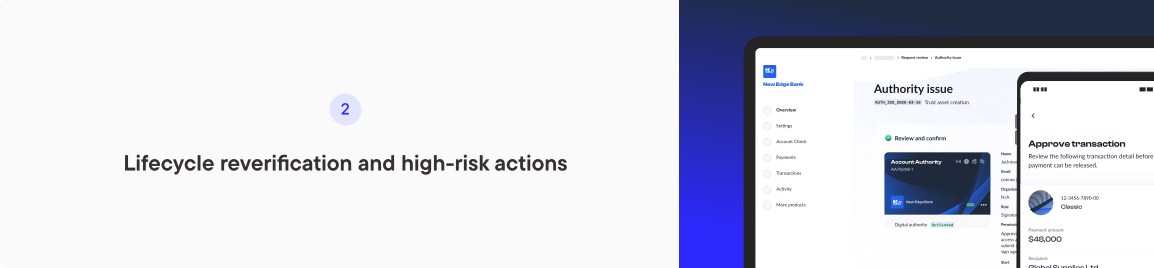
Known customers are often asked to prove themselves again when changing account details, triggering policy thresholds, performing sensitive actions, or recovering access.
Digital credentials can provide an additional trust signal when the bank needs more confidence than a session, device, or behavioural signal alone can provide.
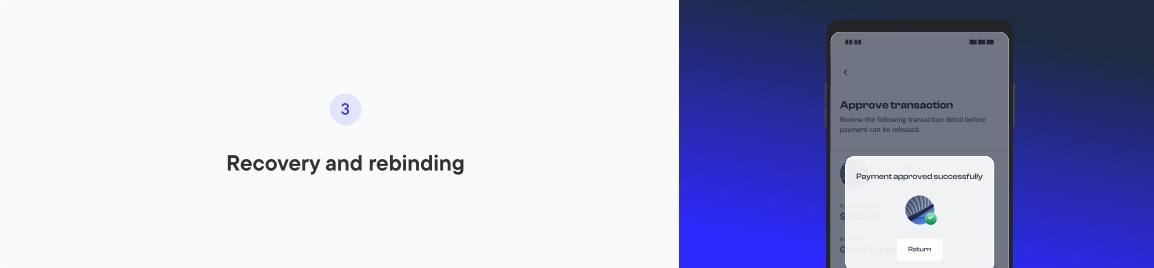
Recovery is one of the highest-risk moments in banking. A credential-backed approach can support some recovery and rebinding journeys by providing a stronger signal that the returning person is linked to previously established trust.
That said, this should be framed carefully. Digital credentials can support recovery workflows, but they do not solve lost-device recovery or wallet recovery on their own. Those require separate controls, fallback paths, and governance.
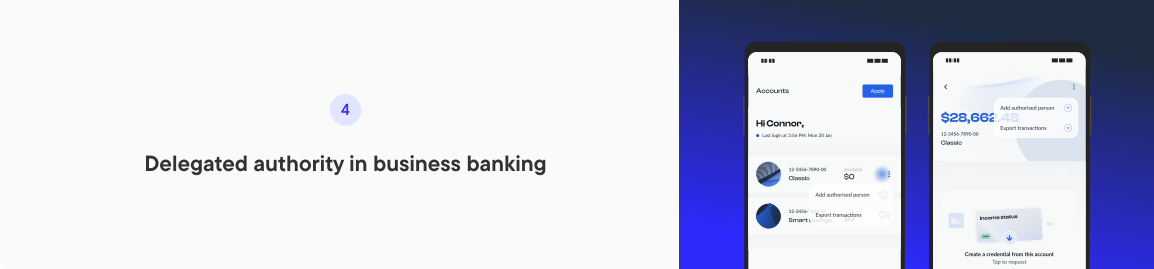
In business banking, a person may be authenticated, but the bank still needs to know whether that person has the right to act for a business, account, mandate, payment, or approval flow.
Credentials can help represent authority in a more structured, scoped, and verifiable way: who can act, for whom, under what scope, and under what conditions.
This may be one of the most practical internal starting points because the operational pain is often visible: manual checks, mandate updates, role-table reconciliation, exceptions, and slow authority changes.

Once internal value is proven, banks may choose to participate more actively in external trust ecosystems.
That could include proving identity to trusted partners, supporting affiliated onboarding journeys, enabling selective sharing of verified attributes, integrating with government digital identity systems, or issuing credentials that become useful beyond the bank’s own channels.
But the strongest path is usually internal value first, ecosystem expansion later.
Pilot paths: acceptance or issuance?
Banks will likely need both capabilities over time.
Acceptance means the bank consumes credentials issued by trusted sources, like governments. This may be useful in onboarding, enrolment, reverification, branch presentation, or high-risk action approval.
Issuance means the bank creates credentials for relationships it already knows to be true: customer identity, account relationship, delegated authority, eligibility, payment-related trust, or business relationship.
The first move should not be ideological.
Some banks will start with acceptance because suitable credentials are becoming available and onboarding friction is measurable. Others may start with issuance because they already hold valuable trust that is expensive to manage or repeatedly revalidated internally.
The right question is: Where does reusable trust create measurable value first?
Infrastructure matters
Turning onboarding trust into reusable value requires more than a credential format.
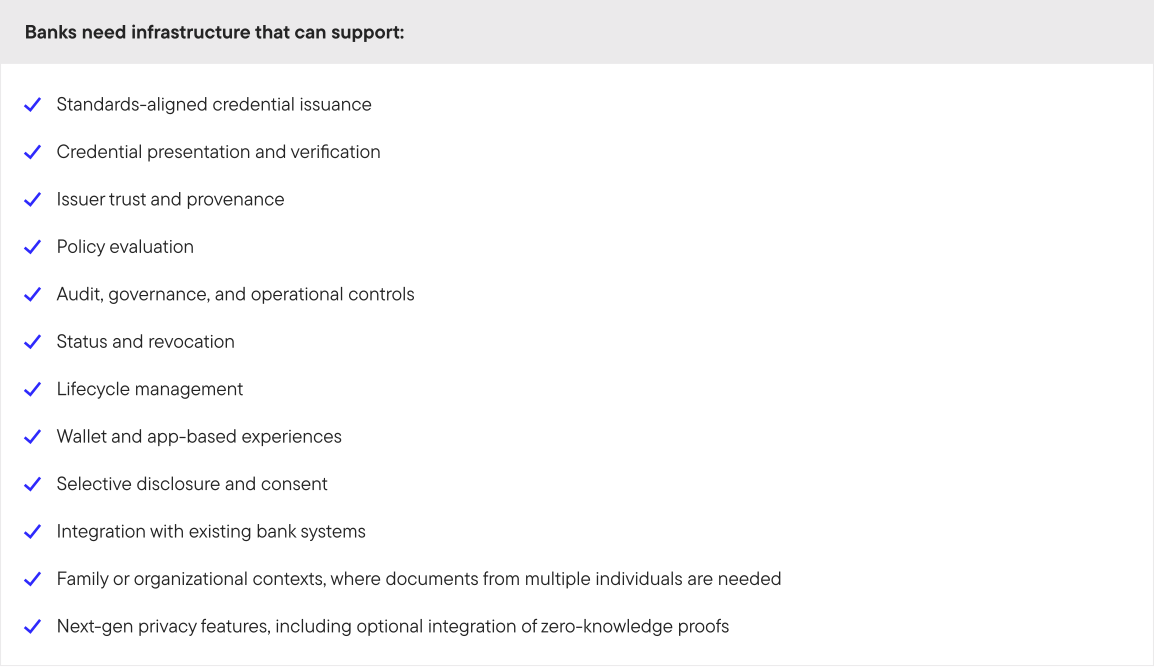
This is where digital credential infrastructure becomes critical.
A bank identity may be the visible asset. The infrastructure underneath determines whether that asset can be trusted, reused, governed, revoked, integrated, and scaled.
Without that infrastructure, credentials risk becoming another isolated channel artefact.
With it, they can become part of a broader trust layer across onboarding, servicing, recovery, delegated authority, and future ecosystem interactions.
Getting practical: start with one trust handoff
The best starting point is not a full bank-wide identity transformation.
It is one measurable trust handoff.
A trust handoff is a moment where the bank needs a customer, account holder, or representative to prove something again.
That might be:
- a customer applying for another product
- a known user performing a high-risk action
- a customer rebinding a device
- a business representative proving authority
- a branch customer moving into a digital journey
- an existing customer re-establishing trust after a risk trigger
The practical path is:
1. Choose the workflow.
2. Define the trust problem.
3. Identify the proof required.
4. Decide whether acceptance or issuance comes first.
5. Define the success metric.
6. Pilot safely.
7. Expand only where value is proven.
This keeps the conversation grounded in measurable business outcomes: reduced cost, improved completion, stronger assurance, fewer exceptions, lower manual handling, and better customer experience.

The next phase of banking identity is not more verification
Banks have spent years improving identity verification, authentication, fraud detection, and digital onboarding.
Those investments remain essential.
But the next opportunity is to make verified trust more reusable.
That means moving from a model where trust is repeatedly reconstructed to one where trusted facts can be issued, held, presented, verified, and governed under policy.
A reusable bank identity is one powerful expression of that shift.
The broader capability is reusable trust infrastructure.That is where banks can turn onboarding trust into ongoing value — for customers, operations, risk teams, digital channels, and future ecosystem participation.
Want to explore where reusable trust could create value in banking?
MATTR’s whitepaper, From Reverification to Reusable Trust, explores how banks can use digital credentials to improve onboarding, high-risk journeys, and delegated authority.
It outlines:
- why repeated reverification creates cost and friction
- how digital credentials complement existing bank controls
- where acceptance and issuance each fit
- which use cases are most practical first
- how to define a measurable pilot